
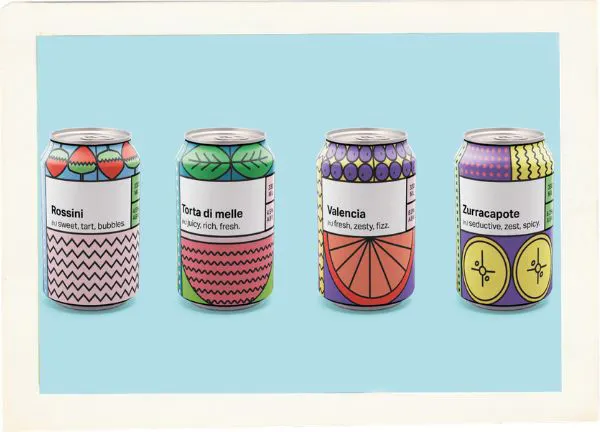
The Department designs packs that get picked up, taken home and bought again.
Range architecture, structural formats, pack design and print production, for products sold from a shelf, a fridge or a screen.
Section 1 — Grounds for a Pack
A pack is the one advertisement every buyer is guaranteed to see, and the only one they pay to take home. It is read at two metres and judged in seconds, surrounded on every side by rivals designed to interrupt it. Most brands lose the shelf before the shopper has finished a thought.
Most of what a customer buys is image, and nowhere is this plainer than at the shelf. Put identical products in plain wrappers and preference collapses; the pack carries the difference. The front of the pack makes the promise. The back provides the evidence. The price is judged against both, and a pack that projects quality permits a price that reflects it.
The commercial effects are measurable. A distinctive pack is found faster on repeat purchase and interrupts habit on the first. It reduces the discounting needed to move the product, because it gives a reason beyond price. And it goes on selling after the sale: in the fridge and in the background of other people's photographs, unpaid.
Section 2 — Procedure: Packaging Development
A pack is the brand at its smallest and hardest-working. The Department designs it with the whole identity behind it, then engineers it to survive print.
Stage 01 — Brand Immersion. Proceedings open with the brand. Clients arriving from Branding & Visual Identity are already on file, and the work proceeds from the existing record. New clients receive the induction: the identity, the position and the promise the pack will be required to carry.
Stage 02 — Shelf Research. The Department surveys the shelf the product must win: the colour codes, claims and formats the category repeats, and the conventions every rival obeys. It records what the category has agreed to look like, then declines to look like it. Customers are studied where they decide: what they check on a pack, what they distrust, and which promise moves a hand from habit to something new. Their words are taken down. The pack is written in their language.
Stage 03 — Range Architecture & Naming. The portfolio is put in order before anything is designed: which products exist, what each is called, how variants relate, and how the range signals good, better and best. Product names are tested for clarity at a glance and for room to grow. The architecture is recorded, and every SKU that follows obeys it.
Stage 04 — Structural & Format. The physical decisions: format, materials, closure, construction and the feel of the thing in the hand. Each option is assessed for shelf presence, unit cost, line efficiency and the moment of opening. Where sustainability is claimed, it is specified rather than implied.
Stage 05 — Design Development. The visual system is applied under shelf conditions. Information is placed in the order a shopper reads it: brand, promise, variant, proof. Every element is tested at arm's length and at two metres before it enters the artwork. A pack that needs to be picked up to be understood has already failed once.
Stage 06 — Compliance & Production. Regulatory copy, declarations, barcodes and print specifications are completed and checked against the market the product sells in. Artwork is prepared print-ready, proofs are inspected, and the Department attends the press where the run warrants it. The small print is set with the same care as the headline, on the grounds that someone always reads it.
Stage 07 — Launch & Range Extension. The pack ships with its own governing documents: packaging guidelines, artwork masters and the rules by which future SKUs join the range without weakening it. The file transfers to you. The Department retains a sample.
Schedule A — Materials Issued on Completion
Shelf and category audit · Customer research findings · Range architecture · Product naming · Structural and format recommendations · Material and finish specifications · Packaging design system · Front-of-pack hierarchy rules · Back-of-pack copy templates · Regulatory and compliance review · Print-ready artwork · Proofing and press supervision · Packaging guidelines · SKU extension rules · Asset library
Cross-Referenced Files
Branding & Visual Identity. The pack extends the identity on file. Where no identity exists yet, that file opens first, and the pack arrives already knowing what to say.
Communication. Campaigns put the product in the story. The pack is where the story is checked against the shelf, so the two are built to agree.
To Proceed
Open a file. There is no fee and no obligation. State the product, the shelf it fights on and the price it needs to justify, and the Department will respond with a route.
END OF FILE